
Awesome evening with Peter Segal and the panelists of Wait Wait Don’t Tell Me. http://t.co/Oz6izZoiW9

Awesome evening with Peter Segal and the panelists of Wait Wait Don’t Tell Me. http://t.co/Oz6izZoiW9
Sorry for all the typos in my Apple Watch post this morning. The afternoon version should be much cleaner. carlhowe.com/blog/apple-wat…
My prediction for Apple Watch shipments thru May 8. Bottom line: a multi-billion dollar business. Details on my blog: carlhowe.com/blog/apple-wat…
Here’s the quick summary for those of you who don’t have time to read the next 3,000 words.
The Apple Watch went on sale for pre-orders on April 10, 2015, and the Apple Store tells us that delivery dates for all orders now stretch into summer and beyond. We know that the initial production run of Apple Watch has sold out; what we don’t know is how many Apple Watches that represents. I’ve built a simple model that predicts that the initial run of watches was more than 3 million units and will yield Apple Watch revenues of over $2 billion for the first two weeks of sales. While this figure is smaller than first weekend sales of iPhone 6 and 6 Plus, it dwarfs all other smartwatch sales to date and represents a milestone in wearable sales. The model suggests that while Sport Watch will lead sales in volume, selling 1.8 million units through May 8, Apple Watch will actually lead in revenue during that period, garnering about $900 million versus Sport’s $675 million. I also believe that Apple’s decision to introduce the Edition will be validated by $500 million in sales on only 40,000 units.
While I believe that these figures will be considerably below the number of pre-orders for Apple Watch, I believe Apple did this for an important reason. Apple is offering 38 different models of Apple Watch and it has no order history to go on. Instead of guessing at the right mix of models to manufacture, I believe that while Apple has manufactured a large number of Apple Watch electronics modules, it will perform the final assembly of actual products—the unique combinations of module, case, and band—to order. This approach will allow it to keep inventory costs low and satisfy as many consumers as possible.
The origins of this model
Now the long version.
In truth, projections like this are really just educated guesses, and mine is no exception. My work nowadays focuses on analyzing big data, though, and some of the techniques we use in that discipline are useful in making such educated guesses.
While I’ve been an industry analyst for nearly 20 years and have had Apple as a client, I have no inside or proprietary information on which to base this model. I have studied Apple’s strategy since the 1990s and have built predictive models about its business during that time using public information (see the section at the end of this posting for my bio and examples). However, I have no insight from Apple itself or from insiders at the firm.
In my experience, Apple runs its business along a few core principles that anyone can observe. Examples include straightforward values such as:
However, those principles drive Apple to use strategies which are at odds with others in the technology industry. Further, Apple’s secrecy around its development process make it very difficult for analysts to predict what the company will do. However, this secrecy does have an advantage for people like me: because I have access to the same public information as the institutional and industry analysts, my model can be as accurate or better than theirs. I also believe that by being transparent in how I come to my figures, I can improve the quality of conversation about Apple and its products beyond “link-bait” articles.
Before I describe the model, I’d like you, the reader, to do a quick thought experiment.
Imagine that someone came to you and asked you to deliver a million Origami (that’s the art of Japanese paper folding) lobsters within the next month. Here’s a link to what one looks like courtesy of Jason Ku via MIT. How would you go about delivering on this order?
The task is clearly possible, but you face two problems: You can’t do it all yourself, and it’s a complex process.
The most straight-forward approach would be to hire about 10,000 of your closest friends to help you. Get some paper to each one of them and have each of them fold 100 lobsters. You gather up the results and you’re done.
There are a few problems with this approach. I don’t know how to fold an Origami lobster, I certainly don’t have 10,000 friends, and I don’t have a million pieces of paper (more like a million and several thousand; I don’t think they will all come out perfectly the first time). Even gathering up the million lobsters at the end is going to be a huge task.
All that said, this still is an achievable task given time and money. You could hire someone to document how to fold Origami lobsters. You could hire 10,000 people to do the folding. You could rent a big building where the people could do the work. You could buy the paper. You could hire people to gather up all the resulting lobsters.
Now let’s make this a little more realistic. As it turns out, we really want a million lobsters of two different sizes. Further, ordinary paper tears too easily and is the wrong color for Origami lobsters, so we’ve decided to make our own paper; that will require its own process. We also need to be able to deliver some of the lobsters with glitter and others with hand-painted decorations; we’ll need to plan to supply and apply those materials too. Oh, and we want to make a few thousand out of two colors of pure gold leaf instead of paper. You’ll have to manufacture the paper for that too.
What’s your plan look like now?
There’s no rush; you can deliver your million lobsters any time during the month, provided that you don’t mind people complaining that you are way too slow at getting this done. Oh, and you’ll be criticized in the international press for every failure to produce perfect lobsters.
And now, imagine this same plan, except with this twist: no one has successfully folded this particular type of Origami lobster before, so you really don’t know how it’s all going to turn out. And your reward if you are successful will not be praise, but demands that you build even more next month.
Congratulations. You’ve just imagined the scenario that Apple executives had to create for the launch of Apple Watch, except that Apple products are orders of magnitude more complex than paper lobsters. Also billions of dollars of revenue hang on you getting this process right the first time; if you don’t, your company and possibly the entire category of smartwatches will be deemed a failure. No pressure at all, really.
This thought experiment is my attempt to help people understand the challenge Apple faces in manufacturing and launching the Apple Watch at the scale Apple works at. Few people appreciate how complex Apple’s supply chain is for new products, especially when consumers worldwide demand these products for immediate delivery. Despite the fact that most Apple product launches make the process look easy, those launches pose multiple challenges that few other companies face including:
I assume that Apple plans to keep these risks to a minimum by eliminating as many unknowns in the manufacturing and production process as possible. Specifically I believe that Apple’s strategy is to:
With these assumptions in hand, we can begin to estimate what initial launch shipments will look like.
The launch of Apple Watch differs from prior launches of iPhones and iPads. Previously, the period between when consumers were allowed to pre-order products and when they would be shipped to them was only one week. With Apple Watch, Apple has left two weeks between the first date of preordering, April 10 and when orders will start shipping, April 24. Further, Apple has not guaranteed deliveries of any products on the first day of availability, April 24. Instead, it has provided all early buyers to expect delivery between April 24 and May 8. I believe this difference is important because it allows Apple to do something it hasn’t done before: Apple can use data from the early sample of pre-orders to guide final assembly and manufacturing of the bulk of products to be shipped.
While data about the pre-orders is scarce, some have gathered slivers of information which may or may not be helpful:
Given that the Slice data only represents one out of the 9 countries in which Apple Watches are sold and that we will have two weeks of store views and pre-orders in place before the first Apple Watches are shipped, I believe that demand will vastly outstrip Watch production through June 2015 and possibly beyond. It would also not surprise me to see China pre-orders exceed those of the US, which means that Apple may have 10 million or more pre-orders on its books by April 24. Therefore, my model assumes that production rates will be the limit of pre-order shipments through June.
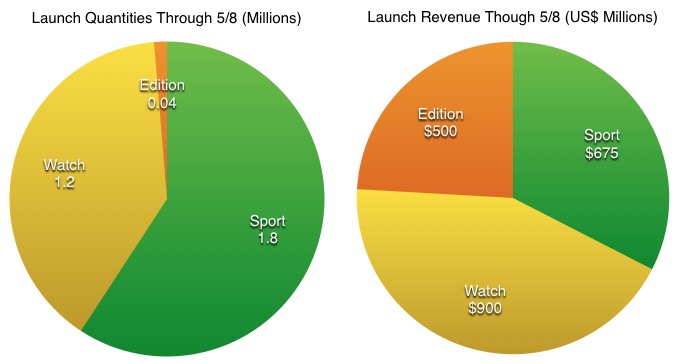
With all this data in place, my estimate of Apple Watch shipments for the period between April 24 and May 8 is as follows (see Figure 1):
Despite this very specific 3.1 million unit estimate, I place a great deal of uncertainty in that figure, just as you probably felt uncertain about your ability to produce a million Origami lobsters in the thought experiment earlier. All it would take is one manufacturing mistake in the Watch module process or a shortage of the fluoroelastomer used to make the Watch Sport bands, and production rates could be much lower. My 3.1 million figure simply represents a reasonable manufacturing plan that matches Apple’s track record in satisfying as many consumers as possible with their latest greatest product while keeping business risks to a minimu.
What about margins on these products? I think I’ll save that analysis for another posting, but my belief is that the Apple Watch product line will become Apple’s most profitable product line ever, with gross margins exceeding 60 percent. Why? Because the core electronics modules in the expensive models are the same ones used in the Sport models, and they just don’t cost that much. And while adding Gold cases and designer bands add cost to the bill of materials, the costs are small compared to the price premiums paid for these products. Unlike in the consumer electronics business, I see no pressure for prices to fall and if anything manufacturing costs will, resulting in a very profitable business.
I believe that the 3 million Watches already in flight to consumers are simply Apple’s seeding of the market prior to adjusting the final assembly mix to the actual order flow. I also believe that Apple and Quanta have probably gained enough experience at this point to begin ramping up production to more than 2 million units a month during May and June, resulting in another 4 million or so units to be shipped prior to the end of the second calendar quarter. I don’t believe that this increased production will satisfy demand however, and I expect Apple Watches to be on back order through much of the summer.
For anyone waiting for a sleeker more refined Apple Watch 2.0, I believe you will have a long wait. Given the challenges in ramping up the production lines for these Watches, I expect that Apple Watch 2.0 will simply be a software update to the existing core electronics with additional bands and possibly another case color. Apple has plenty of room to refine its Watches for at least a year without changing the hardware one bit, and such an approach would amortize its production investments. Further, keeping the platform constant over one to two years ensures that developers have a consistent platform to create software for. To my mind, new Apple Watch 2.0 form factors are likely to wait until 2017, and it’s possible they could take longer than that.
If you insist on waiting for Apple Watch 2.0, though, you might try folding some Origami lobsters while you wait. They aren’t easy.
My bio can be found on the main page of carlhowe.com. While I have analyzed Apple as part of my day-to-day work for nearly 20 years, I now spend my time consulting on big data for Think Big Analytics. This blog post is a labor of curiosity and should not be considered the opinions of my employers.
Readers may reasonably ask why anyone should believe my model over the myriad other forecasts that financial and industry analysts are promoting. After all, estimates of 2015 sales for Apple Watch range from 8 million to 60 million units. Sales of 3 million units on opening weeks would certainly run counter to the overall meme of “you’ll want one but you don’t need one.”
The truth is that none of us know how a brand new product category will sell with consumers. However, in my many years as an analyst and data scientist, I’ve successfully modeled how new Apple products sell many times. Here are a few of my predictions that were written up in the press; you can judge for yourself how accurate they were. Alternatively, you can always Google “Carl Howe predicts” and decide for yourself.