20 Project management
project management
weekly meetings
framing
March 2025
How does a project get to be a year behind schedule? One day at a time. -Fred Brooks in The Mythical Man-Month
Back in the 1980s when I was at Bolt Beranek and Newman, Inc., I was the operating systems software development manager for the BBN Butterfly family of parallel processors. My group was tasked with porting the Mach/Unix operating system developed by Carnegie Mellon University to our new second-generation Butterfly, which was designed around the Motorola 88000 chip and scaled up to 256 processors. All the hardware was new, the chip was unproven, and the system had to scale to more processors that had ever been used before.
Oh, one more thing: we had only 10 months to deliver the system. If we didn’t deliver by April, the project and probably the company was over.
When I discussed these constraints with my boss and my management colleagues, it was clear that we couldn’t afford to lose even a single day for the duration of the project. We had to hit the deadline.
So I instituted what was for me a new process: the daily 5-minute meeting.
At 5 pm every day, my development team would meet with me in my office for roughly 5 minutes. Those 5 minutes were devoted to only 3 topics:
- What got done today.
- What’s the plan for tomorrow.
- What does the group need to overcome any problems they currently face.
My job as manager was the write up the results of that short meeting and to find solutions to the issues identified in topic 3. In exchange, the developers could spend all their time writing software and didn’t have to deal with the usual organizational hassles involved in working within a larger company.
When we started the project, my report went only to the software group and my boss. When hardware started getting delivered (we started software development before the hardware was even complete), the audience then expanded to the hardware group. And then it went to the testing team. And then we added the documentation team, and so on.
By the time the project was over, my daily 3 issue summary had grown to encompass most aspects of the larger project and was read by the entire company. And, much to everyone’s amazement, the project got delivered to our first customers on time.
Nowadays, we’d refer to those daily meetings as Agile development standup meetings. While the Agile Manifesto only appeared about 20 years later, the philosophy was pretty much the same: focus on delivering results every day and communicate regularly to break down barriers to progress.
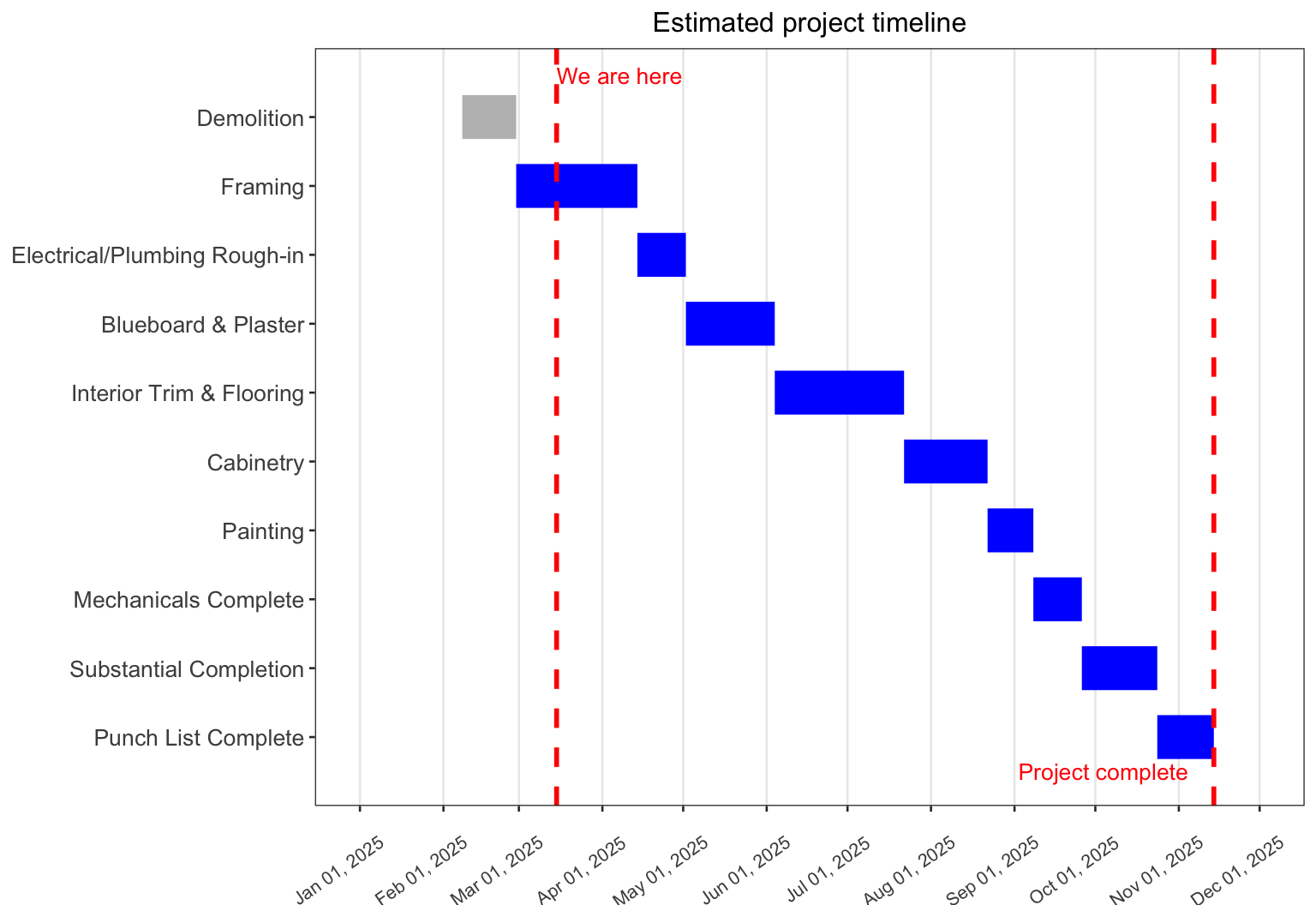
I tell this story because Gilmore’s process for our renovation fit well within the bounds of this process. Upon beginning construction, we now have:
- A project manager. We’ve been assigned Heather as our project manager, who is in charge of overseeing the schedule, payments, and other logistics to keep the project on track.
- An on-site supervisor. Kris is the guy who oversees all the subcontractors who work on our house. Every day that there is someone in the house working, Kris is there to address issues and resolve problems.
- Weekly status meetings on-site. Because we no longer occupy our house, we meet at the house every Tuesday to review progress, address problems, and make decisions.
- Weekly written reports. Every week, Heather emails us a progress report that details what progress has been made in the last week, what’s coming up in the next week, how we’re doing in adhering to schedule, and what possible budget effects there may be.
The weekly meetings have become the high points of our week now. With a full week between visits, the house changes dramatically between visits, so we’re always excited to see what’s new.
This week’s issues
One of the challenges in any renovation is that you never quite know what you’ll find as the project progresses. In our latest meeting, we:
- Changed the laundry room configuration. Our new floor plan has a laundry room next to our primary bedroom. However, the elevator shaft needs 4 inches more floor space than originally had been allocated, so it needs a little rearranging. That said, it’s not a big change, and we approved it.
- Planned to choose materials for the elevator. Our elevator is made by Inclinator, and it offers a wide variety of finishes, flooring, lighting, and painting options. We’re going to have to make a trip to our local installer, Above and Beyond Elevator to do that.
- Discussed the materials and design for the deck. We know we’re replacing our decaying mahogany deck, but because the prior deck wasn’t properly built (the joist spacing wasn’t quite right, and the concrete footings were just add-ons), Gilmore is doing a redesign of the structure. We know we want to use a maintenance free material such as Trex, but we have to specify colors, railing types, and the like. Gilmore’s going to do a redesign of the deck and bring Trex samples for a subsequent meeting.
- Specified Decora light switches. We’ve decided to replace all the toggle light switches in the house with paddle switches, which require less force and manual dexterity to manipulate.
We’re still on schedule and budget, though, so things are looking good.