1 How we decided to renovate our home
February 2023
 Carolyn and Carl skiing at Canyons Ski Resort, Park City, Utah
“We are all just temporarily able-bodied.” – Chris Luden, Sean Crump, and many others
Our decision to renovate our home for accessibility came about from several life experiences over the past decade or so:
The photo at the top of this post was taken in 2015 by a friend at the top of one of the mountains at Canyons Village (now part of the huge Park City Ski Resort) in Utah. It was taken about 20 minutes before Carolyn hit an icy spot on the way down the mountain and broke her leg. While it was a relatively simple tibia plateau fracture, she still had to hobble around on crutches for a couple months. Needless to say, that made navigating the many flights of stairs in our house challenging.
In 2021, I developed a metabolic disorder (later diagnosed as non-Hodgkins lymphoma, of which I’ve fortunately been cured) that gave me hypercalcemia. Hypercalcemia is a condition where you have too much calcium in your system, and for me, it caused mental confusion and balance issues, which made our stairs quite dangerous for me to descend.
Just was we were preparing to move in 2025, Carolyn missed a step on our stepladder when getting a box down from a cupboard. She fell on the floor and suffered two displaced pelvic fractures. While she didn’t need crutches this time, she was in a lot of pain every time she climbed or descended stairs.
After experiencing three separate incidents where we found our stairs difficult, we decided we should do something about it before some unknown future event limited us or (horror of horrors) forced us to move.
Our goals for the renovation
“Chase goals like you chase the free samples at the farmer’s market.” – Zach Zeal
“I hate to move” has been my mantra for most of my life, and it has served me well. I’ve lived in only 4 apartments or houses since graduation from college. As I look forward to my golden years, I’d like to maintain my streak.
As I noted in the introduction, our primary goal in this home renovation was to allow our family to age in place within a house that has 7 different levels of living space. However, as we started to examine what the term “aging in place” actually meant to us, we broke it down in to a collection of sub-goals. We wanted our renovation to include:
- Access to most levels of the house for someone on crutches or in a wheelchair. Should either of us become unable to climb stairs, we’d still like to access the 7 floors in our house, including the two levels in our basement where we store things.
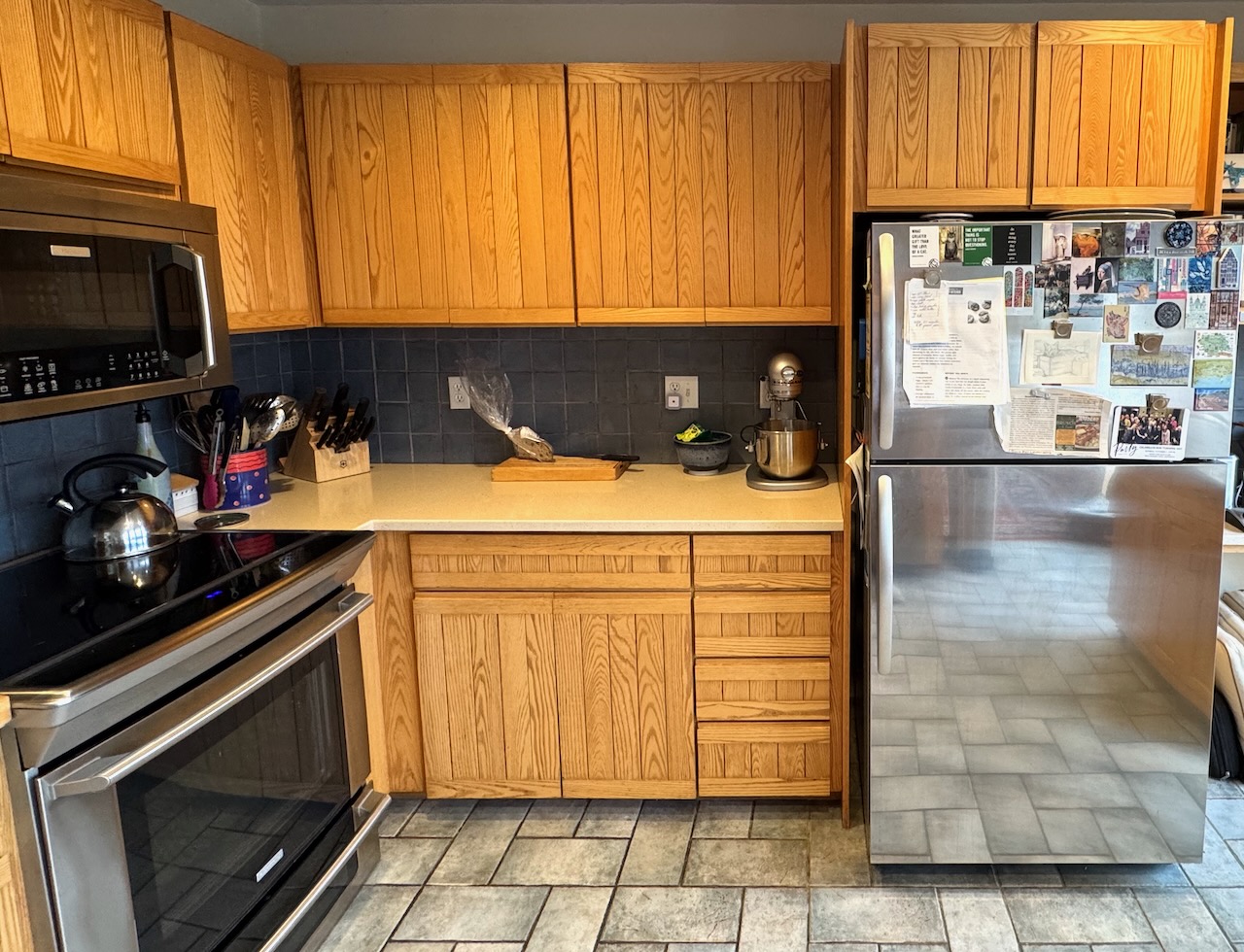
- A kitchen design that would accommodate a full-sized refrigerator and stove. Because of an overhead and inconveniently-placed cabinet, we’ve lived with an apartment-sized refrigerator for the last 22 years, along with a 30-inch wide stove. We’d like to break free of those limitations.
- Good ventilation for our kitchen. The range that came with the house was a Jenn-Air that vented downward. We later replaced that with a different electric stove that didn’t include a vent, and the microwave cabinet above didn’t allow us to install a new one. The result: we’ve lived with bad ventilation in our kitchen for decades.
- Bathrooms adapted for limited mobility and wheelchair access. We want to be able to shower and bathe safely even if we’re in a wheelchair. Further, we want toilets that we can use easily even if we difficulty moving or bending over.
- A laundry room near the primary bedroom. We don’t want to risk carrying a laundry basket on stairs, and having the laundry near where we get dressed practically eliminates the need for a laundry basket altogether.
- Door widths and other adjustments suitable for someone in a wheelchair. Should we be confined to a wheelchair at some point, we’d like to be able to still navigate the house. That means we need wide doorways and passageways.
- Low maintenance materials and systems. We love having a natural wood deck, but we recognize that we won’t be able to do all the routine sealing and staining necessary for wood as we get older. We plan to apply this principle to other modifications such as our front door stairs and walk.
- High efficiency and green systems and appliances. We already have a variety of “green” systems in our house. Because our house faces due south, we have several passive solar management systems such as powered shades and awnings. We want to continue to reduce our carbon footprint in our renovated home.
Goals mean nothing without constraints
“How could God create the universe in six days? He didn’t have an installed base of customers.” – Old software joke
Let’s face it: renovations would be a piece of cake if we had lots of land to build on, infinite time, and an unlimited budget. Unfortunately, none of those conditions applied to us.
Our primary constraints were that the project should:
- Comfortably accommodate the four adults and two cats that currently live in the house. Our house is officially a 4 bedroom house, but we use one of those bedrooms as our den. With two adult sons living with us, we don’t want to lose any living space.
- Retain and/or expand our view of the valley below. As noted in my first post, our house is sited on the side of a hill. It overlooks one of Stow’s many apple orchards and parts of Hudson, Marlborough, and Sudbury. We don’t want to lose any of those views and if possible, we’d like to expand them. The photo below gives you a sense of what we wake up to:

- Recycle as much as possible. We don’t want to throw away many of the features that make our house unique, such as the many living levels, the large expanses of glass, and our big decks that act outdoor rooms during temperate months. While it’s been trendy the last few years to tear down houses and build something new, we don’t want to incur that type of environmental and financial cost.1
- Be something we can afford. While we do have substantial resources to devote to this project, almost all of that is tied up in retirement savings. That makes those assets difficult to access for a big project like this, so we need a strategy that preserves as much as possible for future health care and living expenses.
1 Actually, we did consider tearing down the house and starting over, but our architect estimated the cost to do that in Massachusetts would likely have too many zeros to be practical (i.e., it would be multiple millions of dollars). We decided that was not in our budget.
The bottom line: we decided we really wanted to remodel instead of rebuild our house. However, to fully understand what we wanted to do, we had to take a good hard look at what was already in place and what was possible in terms of changes. As the title of this book says, we plan for this to be our first and last major renovation of our lives, so we want to do it right.