6 A conversation piece: the 6-stop elevator
January 2024
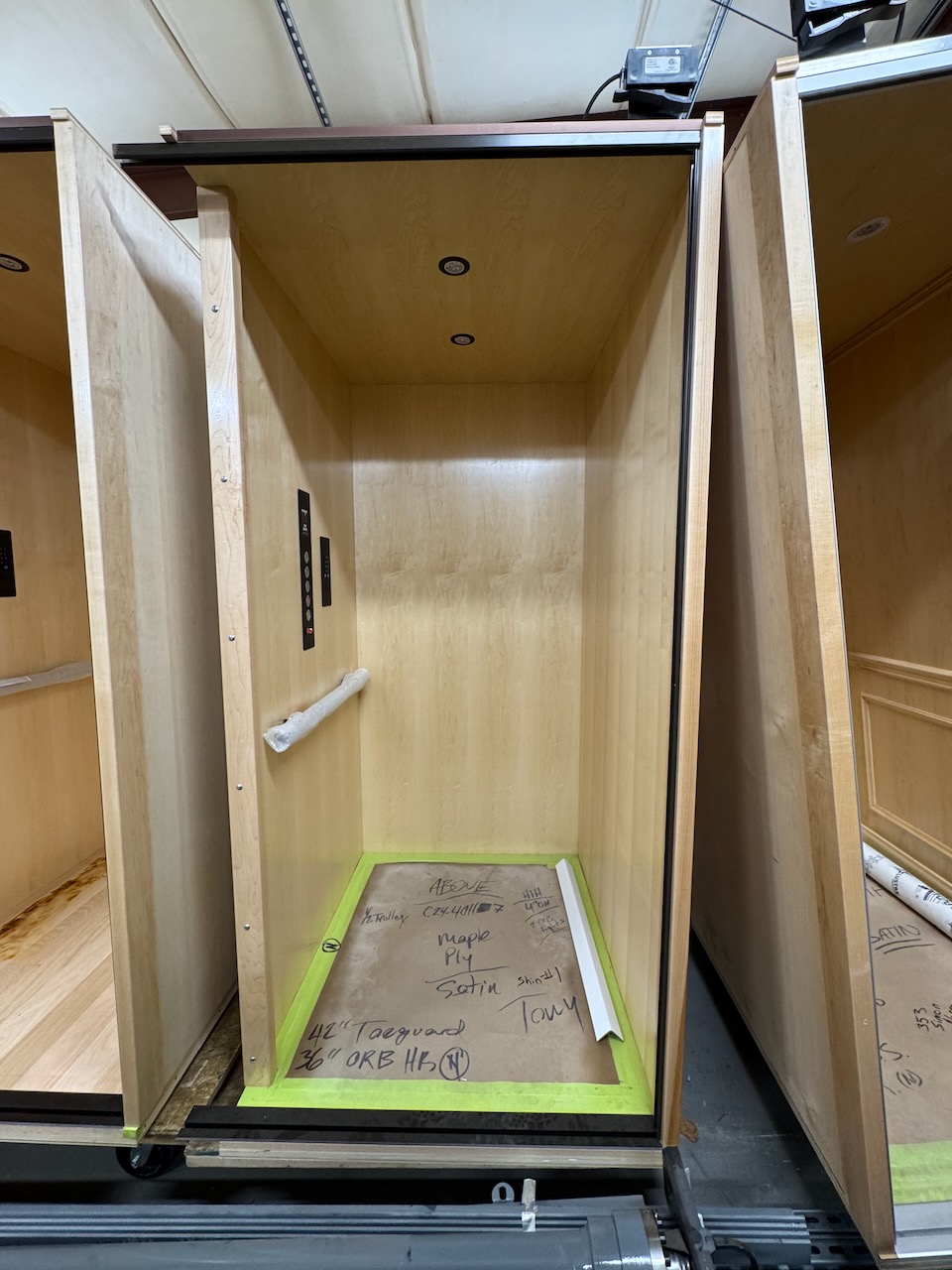
An elevator cab destined for another customer at Above and Beyond’s headquarters.
Whenever I have described adding an elevator for our aging in place renovation, the reaction I typically get is, “Really? An elevator in your house?”
My response is simply that times have changed. With prices starting around $15,000, residential elevators are not just for billionaires any more.
Some of this is technology. High-volume production electric cars have dramatically reduced the costs of powerful electric motors used in residential elevators.
However, the biggest factor driving adoption is the one that got us started on this project: demographics. The baby boom generation is getting older, and like us, many of those boomers want to age in place. In fact, elevators have become so mainstream that home renovators such as Bob Villa and This Old House have written articles about how to choose and install them.
Anne toured our house with us to determine our requirements for the elevator early in the architectural design. During that tour, she dispelled some of my pre-conceived notions about what we needed from our elevator. In the process, we decided we:
- Should have the elevator stop at every floor. I had originally thought we would only need one stop in our basement, but Anne convinced us that even if we were wheelchair-bound, we’d still want to be able to store things in both levels of our two-level basement. If we add that to the need to stop at 4 out of the 5 other levels of the house, we need an elevator that can make 6 stops and have doors on both sides of the elevator shaft. It can’t go to the top floor of the house because we need to put the elevator hoist there.
- Could accommodate an elevator pit and machine room in our basement. Most elevators require an elevator pit and dedicated machine room in the basement of the building. While some elevator designs do avoid those ancillary bits, an elevator with 6 stops really can’t. Fortunately, we have room to install those features in the lower basement.
- Would have enough electrical power to support an elevator. Because our home is nearly all-electric, we would like our elevator to be electric instead of hydralic. The problem is that our 200 amp breaker panel is already full, and we’ll need another 50 amp breaker for the elevator. Knowing that upgrading to 400 amp service on our street would set back our project by months if not years, we sketched out a plan to repurpose some existing circuits and stay within our power budget.
Anne found an electric elevator that meets our requirements that’s made by Inclinator. While our 6-stop requirement is at the top end of what their electric elevators can accommodate, we are fortunate that our stops are really at half, not full floors. If we’d had 6 full floor stops, our elevator shaft would be 50 feet tall, and that’s close to the limit for residential elevtors; as it is, ours will only have to be about 35 feet because our stops are only a half-floor apart.
Call me crazy, but if nothing else, this elevator is going to make one heck of a conversation piece.